
What caught buyers’ eyes, and what got them enquiring on MyProperty in 2026 Q3?

MyProperty & Entegral Founder
Published 24 November 2026
·3 min read
Property portals rarely share detailed insights into lead statistics. One reason may be that the numbers invite tougher questions: are agents getting good value for the fees they pay? With pay-per-lead models common with top portals in most countries, it makes sense for the portal to focus on generating as many leads as possible to push revenue - irrespective of the quality of the lead. The result is that this has turned into a lucrative revenue machine for most portals, but a resulting admin and cost overhead for many agents. There are many inefficiencies we see, scattered throughout the real estate value chain, that ultimately lead to agencies having to recover costs through higher commission fees, impacting the pocket of the seller, who pays the commission.
Fewer leads for agents
MyProperty operates as a free-to-list model with optional paid packages and tools for agents. Coupled with our independent status, it helps in our mission to bring more transparency to the real estate transaction as we can be unbiased in how we present and rank listings and agents and control the quality of the leads we send to them.
Earlier this year we started deploying spam checks and introduced qualifying questions when you enquire on a property, which gives the agent more context on where you are in the journey. This has unfortunately also resulted in almost 50% fewer leads being delivered, but gives you an indication of how big this problem is for agents.
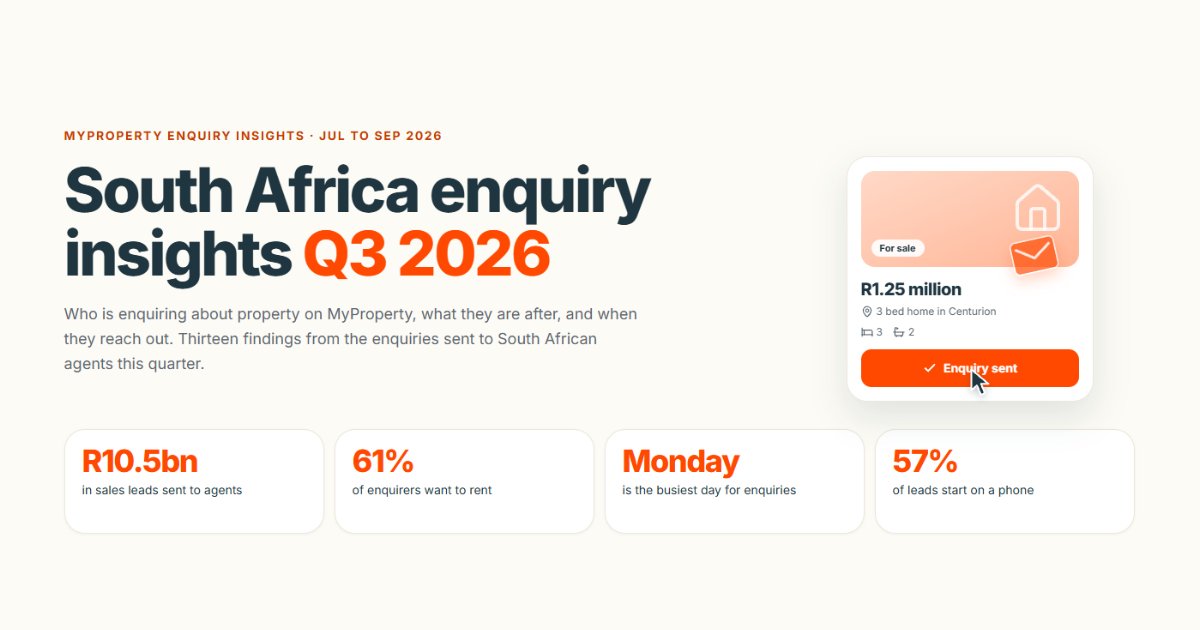
With this in mind, and to give you some insights into our lead activity, we've compiled our 2026 Quarter 3 Lead report which reveals some interesting statistics.
You can browse through the interactive property lead report here, which delivered a healthy R10 billion in free leads to agents (with the value the sum of the property asking prices enquired upon). This excludes telephonic and direct-to-agent enquiries.
Based on the input at the time of enquiry, we can see around 3 out of 10 buyers planning to pay cash on a national basis - and when I dive into the data in our backend I can see which areas have the highest concentration of cash or home loan buyers. Our qualifying questions that are included with our enquiries to agents help provide more context so that the conversation has a clear starting point.
Lead response time is not something we track at the moment. I know a few portals have started to rate agents based on response time which, in my opinion, is a bit unfair, given the high occurrence of spam I've highlighted, and that many leads are delivered after hours. We did however find that Mondays are the busiest day of the week when it comes to enquiries we generate, and that 1 in 4 enquiries are sent after 6pm.
Explore the insights and let us know what you'd like to see next, or how we can improve the property search experience.
Never miss a property story
Get our latest news straight in your Google feed.
More in Technology

How AI is being used to scam property buyers and sellers
The integration of artificial intelligence (AI) in real estate has revolutionised property transactions, offering tools for better property analysis and customer engagement. However, criminals are exploiting these advancements to perpetrate sophisticated scams that can be used to target property buy...
Read more →
10 Things you need to know about solar in South Africa
Due to load-shedding as well as the soaring cost of electricity, thousands of South Africans are investigating their options with regard to solar power. Understandably, they have a lot of questions. Solar energy experts Versofy SOLAR received more than 5 000 enquiries around home subscriptions since...
Read more →
How this South African property company is using Cryptocurrency
As cryptocurrency continues to make its way into everyday life, affordable residential and student housing specialist Quorum Holdings will accept rental deposits in cryptocurrency, and to allow tenants to potentially benefit from an increase in value - the first to do so in South Africa.
Read more →How AI is being used to scam property buyers and sellers
The integration of artificial intelligence (AI) in real estate has revolutionised property transactions, offering tools for better property analysis and customer engagement. However, criminals are exploiting these advancements to perpetrate sophisticated scams that can be used to target property buy...
Read more →10 Things you need to know about solar in South Africa
Due to load-shedding as well as the soaring cost of electricity, thousands of South Africans are investigating their options with regard to solar power. Understandably, they have a lot of questions. Solar energy experts Versofy SOLAR received more than 5 000 enquiries around home subscriptions since...
Read more →How this South African property company is using Cryptocurrency
As cryptocurrency continues to make its way into everyday life, affordable residential and student housing specialist Quorum Holdings will accept rental deposits in cryptocurrency, and to allow tenants to potentially benefit from an increase in value - the first to do so in South Africa.
Read more →