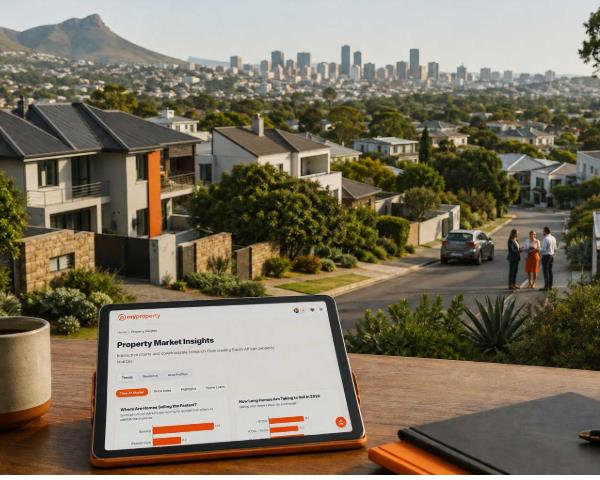
South Africa’s housing market remains resilient, with properties selling faster and estate agents becoming more optimistic about the months ahead. However, the latest data also shows a market where affordability remains under pressure and buyer demand is not equally strong across all price segments and regions.
According to the FNB 3Q26 Estate Agent Survey, the average time a property spends on the market declined to ten weeks and one day, the fastest selling pace recorded since 2022. At the same time, 63% of estate agents said they were satisfied with current market conditions, up from 59% in the previous quarter.
While these are encouraging signs for sellers, the broader picture is more nuanced. First-time buyer participation has declined, market activity has softened slightly, and three-quarters of properties are still selling for less than their asking price.
House-price growth remains positive but is slowing
The FNB House Price Index recorded annual growth of 4.9% in August 2026, down from 5.3% in July and a peak of 6.1% in March and April. This means property prices are still rising, but the pace of growth has begun to moderate. FNB expects nominal house-price growth to move closer to 4.5% over the remainder of the year.
The slowdown reflects softer economic conditions and continued pressure on household finances. However, limited housing stock, higher construction costs and resilient demand among financially secure buyers are helping to prevent a sharper decline in prices.
For buyers, slowing growth could create a little more room to negotiate, particularly where a property has been on the market for longer or was initially priced too ambitiously. It does not, however, mean that prices are falling across the market. For sellers, the data reinforces the importance of launching at a price that reflects current local demand rather than relying on the stronger growth recorded earlier in the year.
Homes are selling faster
The average time on the market fell to ten weeks and one day during the third quarter. Only 53% of properties remained listed for three months or longer, which FNB notes is better than historical norms.
Faster selling times suggest that well-positioned and correctly priced homes can still attract committed buyers, even in a more affordability-conscious market. However, a faster market does not guarantee that sellers will achieve their full asking price. Approximately 75% of transactions were concluded below asking price. The average discount was 8%, indicating that buyers still have some negotiating power, but sellers who price realistically may be able to complete a sale without making an excessive concession.
The practical message for sellers is straightforward: the first few weeks after listing matter. An unrealistic asking price can cause a home to lose momentum, while a market-related price can encourage stronger early interest and reduce the need for larger price cuts later.
Agent confidence improves despite softer activity
Agent sentiment improved during the August survey, with 63% of respondents satisfied with prevailing market conditions, compared with 59% in the second quarter. Agents also became significantly more optimistic about the short-term outlook. The proportion expecting activity to increase over the next three months rose from 20% in May to 51%. Seasonal demand and limited available stock were among the main reasons cited for the improved outlook.
Current market activity, however, slipped from 6.0 to 5.7 out of ten, and only 15% of agents described conditions as highly active. This apparent contradiction reflects a market that is operating more efficiently without necessarily attracting a much deeper pool of buyers. Properties are moving faster, but demand remains concentrated among households that can manage current purchase prices and borrowing costs.
First-time buyers remain under pressure
One of the clearest signs of continued affordability pressure is the decline in first-time buyer participation.
First-time buyers accounted for 26% of market activity in the third quarter, down from 32% in May. As these buyers are generally more dependent on home-loan finance and have less equity available from a previous property, they are particularly sensitive to interest rates, living costs and income growth.
FNB reports that household incomes are struggling to keep pace with property values. This, together with still-restrictive financing conditions, is limiting demand in the lower- and middle-priced segments of the market.
Cash buyers, by contrast, account for approximately 20% of market activity and continue to provide support, particularly in more expensive segments. Buy-to-let demand has also remained relatively resilient.
For prospective first-time buyers, careful preparation is increasingly important. Checking affordability, reviewing credit records, accounting for transfer and ongoing ownership costs, and obtaining home-loan prequalification before beginning the search can help buyers focus on properties that fit their actual budget.
Market conditions differ across price bands
The strongest conditions were recorded above R3.6 million. This segment achieved the highest activity rating at 6.3 out of ten, while 72% of agents operating in the segment were satisfied with market conditions.
Higher-income households tend to be more financially resilient and are less dependent on highly leveraged home loans, helping to support activity at the upper end of the market. Homes priced below R750,000 continued to attract demand but took the longest to sell at an average of 11 weeks and two days. This segment also required the largest average discount from asking price, at 12%.
This points to an important affordability tension: demand for lower-priced homes may be strong, but prospective buyers’ purchasing power remains constrained. The middle-income market is also under pressure from elevated debt-servicing costs and subdued income growth. In the R750,000 to R1.6 million segment, 88% of sales were concluded below asking price—the highest proportion recorded across the price bands surveyed.
Western Cape properties sell considerably faster
Regional performance remains uneven, with the Western Cape continuing to stand out for its selling pace. Properties in the province took an average of four weeks and six days to sell, compared with 12 weeks and four days in Gauteng, nine weeks and one day in KwaZulu-Natal, and ten weeks and four days in the Eastern Cape.
The percentage of properties sold below asking price also differed by region:
- Gauteng: 83%
- KwaZulu-Natal: 72%
- Eastern Cape: 68%
- Western Cape: 60%
FNB attributes the Western Cape’s relative strength to factors including inward migration, constrained supply and comparatively favourable economic conditions. Gauteng recorded the longest selling time and the highest proportion of transactions below asking price, pointing to greater negotiating power among buyers.
KwaZulu-Natal recorded the lowest agent-satisfaction level at 54%, although its activity rating remained relatively resilient at 5.8 out of ten. The Eastern Cape recorded the highest agent satisfaction at 73%, despite selling times remaining notably longer than in the Western Cape.
These differences show why national averages should only be used as a starting point. Conditions can vary significantly between provinces, cities, suburbs and even individual price bands within the same area.
What does this mean for buyers and sellers?
For sellers, the improving selling time is encouraging, but pricing remains decisive. Most properties are still selling below asking price, and buyers are paying close attention to value. A comparative market analysis from an experienced local property practitioner can help establish an asking price based on recent activity in the immediate area.
For buyers, slower house-price growth and the prevalence of below-asking-price sales may create negotiating opportunities. However, limited stock in sought-after markets means desirable, correctly priced homes can still move quickly. Buyers should have their finances ready and avoid assuming that every seller will accept a substantial discount.
For first-time buyers, affordability remains the biggest hurdle. Looking beyond the purchase price to monthly repayments, municipal charges, levies, insurance and maintenance will provide a more realistic view of what a home will cost to own.
A resilient but increasingly selective market
The latest FNB survey describes a housing market that is functioning efficiently but is not being supported equally across all buyer groups.
Homes are selling faster, agent expectations have improved, and house prices continue to grow. Yet first-time buyer participation is falling, current activity remains subdued, and affordability continues to shape what buyers can purchase and how sellers need to price.
In this environment, local insight and financial preparation are particularly valuable. Sellers need accurate, area-specific pricing, while buyers should understand their full budget and be ready to act when the right property becomes available.